
Bran Castle
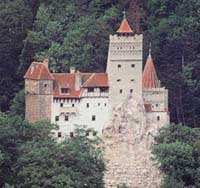 |
| Bran Castle |
According to the legend, there was an old man, called Bran
who had many sons and offered each of them one of his fifteen villages which
were scattered along the road linking villages formed a real fortress, 30
kilometers far from Brasov, where Piatra Craiului Mountain detached from the
massif of Bucegi. They were the perfect combination between natural and human
elements. The pass was dominated by Bran Castle, built on a rock, which was
mentioned in the same medieval documents under the name of “Lapis Theodorici”.
It reminded the existence of an ancient Roman road which started from the
banks of the Danube, continued through the pass of Bran and reached the center
of Dacia, according to a fourth century map.
The first documentary attestation of Bran
Castle is the letter written in 1377 by the Hungarian Ludovic I D’Anjou,
giving the inhabitants of Brasov some privileges. At the end of the 14th
century, king Sigismund gave up the leadership of Bran Fortress in favor of
Mircea cel Batran. The royal domain had been given to the Hungarian
aristocracy, while the Fortress passed under the rule of Mircea’s faithful
boyards. Few years later, the Hungarian king got back the Fortress. Bran
Fortress was subordinated to the authority of Szeklers Committee. The Fortress
had an essential part in protecting the Hungarian king from the Ottomans
invasion, coming from Wallachia through Rucar Pass. That’s the reason why the
inhabitants of Brasov built the Castle on their own work and expenses. Iancu
de Hunedoara fortified Transylvania’s borders and also the towers of the Bran
Castle. He made sure the rights of the paysans were respected by the boyards
who ruled the Fortress.
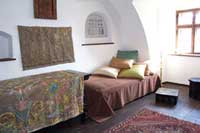 |
| Inside Bran Castle |
The castle had a protective and commercial purpose. The
defense position had two rows of walls closing the passing towards South. They
were made in stone and brick. Only few traces of the initial defense position
still exist. The undersized building of the ancient Post Office had a pit with
6-8 rooms and a cellar also used as prison. It hasn’t been preserved. At that
time the fortress comprised the exterior wall, the donjon, the round tower and
the gate’s tower. The wall was built in stone blocks and bricks and had
rectangular fire holes as had all Transylvanian fortresses. The donjon was
located on the North side and comprised four floors and only two chambers. On
the top there was an observation point. Since 1593 the round tower has a
circular section. At its pit the ancient inhabitants used to deposit the gun
powder. The first and the second floor comprised few chambers. Initially the
gate’s tower was round, but it was rebuilt in 1625 in rectangular form. The
gate was blocked with beams. The only way of reaching this entrance was by
climbing up a ladder. Inside the courtyard you can still see the initial well
(57 m high).
While centuries passed by changes have been
made to the castle. In the 16th century the wax-paper from the windows was
replaced with glass and the shingle from the roof with tile. Many of the
changes and reparations have been made by the prince Gabriel Bethlen. He added
another rectangular tower, a square tower with two floors and the actual gate.
The old observatory tower, dated 1622, shows the Romanian architectural style.
At that time the villagers’s houses were located on the North side of the
castle. On the first floor there was a vestibule, a big dinning room, a
kitchen and under the stairs a small room where they kept the gun powder. The
second level comprised also a vestibule, a small chamber with a door towards
the new tower, a room with short beams, a small room and a corridor made in
wood (the exit towards the courtyard).